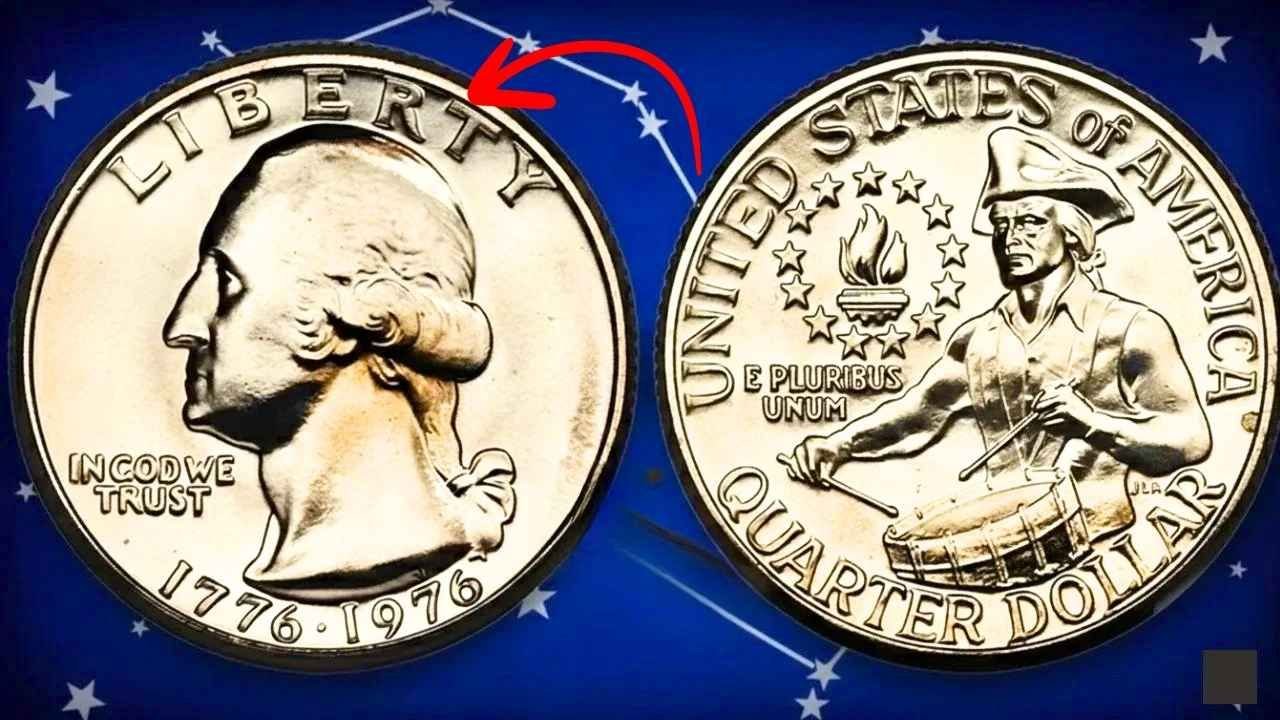
Coin collecting has long captured the imagination of those who appreciate history, craftsmanship, and the possibility of uncovering hidden value. Few coins have generated as much modern curiosity as the Bicentennial Quarter, issued in 1976 to commemorate 200 years of American independence. Stories circulating online often suggest that a single Bicentennial Quarter could be worth unimaginable sums, even billions of dollars. While such claims are exaggerated, the truth behind these coins is still compelling. Certain Bicentennial Quarters are genuinely rare, valuable, and highly sought after, making them an important topic for collectors and investors alike.
The Origin of the Bicentennial Quarter
To mark the nation’s bicentennial, the United States Mint introduced a special quarter featuring a one-time reverse design. Instead of the traditional eagle, the reverse depicted a colonial drummer with a torch of victory encircled by thirteen stars, representing the original colonies. Designed by Jack L. Ahr, the coin symbolized patriotism, unity, and historical reflection.
The obverse retained George Washington’s portrait but carried a dual date, “1776–1976,” a feature unique to the bicentennial series. These quarters were produced at the Philadelphia, Denver, and San Francisco mints and released into circulation beginning in 1975, continuing through 1976. Their widespread distribution ensured that nearly every American encountered one, which is why most remain common today.
Why Most Bicentennial Quarters Are Not Rare
More than a billion Bicentennial Quarters were minted, making the majority worth little more than face value. Circulated examples are abundant, and even well-preserved pieces are easy to find. This high production volume is the primary reason why most Bicentennial Quarters do not carry significant monetary value.
However, rarity in coin collecting is not determined by age alone. Instead, value is driven by scarcity, condition, composition, and unique characteristics. Within the massive bicentennial mintage, a small number of quarters stand apart due to special minting processes, errors, or exceptional preservation.
What Makes Certain Bicentennial Quarters Valuable
Some Bicentennial Quarters command higher prices because they differ from standard circulation strikes. Key factors that increase value include silver content, mint errors, proof finishes, and professional grading. Coins struck in limited collector formats or with noticeable production anomalies are especially attractive to experienced collectors.
San Francisco produced special proof and silver-clad versions specifically for collectors. These coins were never intended for circulation and often display sharper details and superior finishes. In addition, a small number of Bicentennial Quarters exhibit minting errors such as off-center strikes, doubled dies, or die cracks, all of which can significantly increase value.
The Reality Behind the “Billionaire Quarter” Myth
The idea that a Bicentennial Quarter could make someone a billionaire is largely a product of online exaggeration. No quarter, Bicentennial or otherwise, has ever sold for anywhere near that level. Such claims often arise from misunderstandings, sensational headlines, or misrepresented listings.
That said, rare coins have achieved impressive prices at auction, sometimes reaching six or seven figures. These results fuel speculation and keep public interest alive. While a Bicentennial Quarter is unlikely to change someone’s financial destiny overnight, select examples can still be worth far more than most people expect.
Actual Market Values of Bicentennial Quarters
Understanding realistic values helps separate fact from fiction. Standard circulated Bicentennial Quarters typically trade at face value or slightly above, depending on condition. Uncirculated examples may sell for a few dollars, particularly if well preserved.
Silver-clad Bicentennial Quarters from San Francisco proof sets generally range from modest premiums to higher prices depending on demand and condition. Professionally graded coins in exceptionally high grades, such as MS-67 or better, can sell for several hundred dollars. Rare and dramatic mint errors may reach into the thousands, especially when certified and authenticated.
While these prices are substantial compared to face value, they remain grounded in the realities of the numismatic market rather than sensational speculation.
The Importance of Coin Grading
Condition plays a critical role in determining a Bicentennial Quarter’s value. Professional grading services evaluate coins under strict standards, assigning grades that reflect wear, surface quality, and strike detail. For modern coins like Bicentennial Quarters, small differences in condition can result in large differences in price.
Coins graded at higher mint-state levels are scarce due to the way most quarters were handled in circulation. Proof coins with deep contrast and flawless surfaces are especially desirable. Grading provides transparency and confidence, making it essential for anyone considering selling or investing in rare examples.
Historical and Cultural Appeal
Beyond monetary considerations, the Bicentennial Quarter holds lasting cultural significance. It represents a national milestone and reflects a unique moment when history, art, and everyday life intersected. Many collectors value these coins for nostalgic reasons, recalling the patriotic celebrations of the 1970s and the sense of shared heritage they represent.
The design itself stands apart from standard U.S. coinage, adding to its enduring appeal. Even common examples often find a place in collections simply because of what they symbolize.
Investment Perspective
From an investment standpoint, Bicentennial Quarters are best viewed as collectible assets rather than speculative windfalls. Rare, high-grade, or error coins may appreciate steadily over time, especially as collector interest grows and certified populations remain limited.
Like all collectibles, coin investing requires research, patience, and a long-term outlook. The Bicentennial Quarter can complement a diversified collection, offering historical depth and moderate upside rather than unrealistic expectations of extreme wealth.
Conclusion
The notion that a Rare Bicentennial Quarter could make someone a billionaire belongs more to legend than reality. While no such coin has ever reached astronomical valuations, select Bicentennial Quarters are genuinely valuable and highly collectible. Their worth lies not only in market prices but also in historical significance, artistic distinction, and cultural memory.
For collectors, the Bicentennial Quarter represents a tangible link to a defining chapter in American history. For investors, it offers measured potential grounded in rarity and condition. Whether discovered in a collection or carefully acquired, these coins continue to capture attention, proving that true value often lies in history, not hype.